




AI in the Labor Market: What Real Usage Data Reveals
A new study published by Anthropic sheds light on how artificial intelligence is already shaping the labor market. Unlike many earlier analyses that focused on the potential impact of AI on work, this research examines real interactions between users and AI systems. The study analyzes millions of anonymized conversations with the Claude.ai system to understand which professional tasks are currently supported by AI and in which occupations AI tools are used most often.
This approach makes it possible to compare theoretical AI capabilities with actual observed usage in everyday work.
AI adoption is concentrated in knowledge-intensive occupations
The results indicate that AI tools are currently used most frequently in occupations that rely heavily on information processing, writing, programming, and analytical tasks. In particular, high levels of AI usage appear in:
- Computer and mathematical occupations – e.g. generating code, debugging programs, explaining algorithms, or assisting with software documentation.
- Business and finance – preparing reports, analyzing market data, summarizing financial documents, or drafting business communication.
- Management – drafting strategic documents, preparing presentations, writing meeting summaries, or structuring decision analyses.
- Legal services – summarizing case law, drafting legal documents, analyzing contracts, or preparing legal arguments.
- Arts and media – generating content ideas, editing texts, creating scripts, or assisting with marketing communication.
In these occupations, AI tools are often used as productivity assistants, helping professionals complete cognitive tasks faster and more efficiently.
Lower AI usage in physically oriented professions
At the same time, the study shows that AI usage remains relatively limited in occupations that involve physical work or direct service provision. Examples include:
- construction and installation work
- agriculture and grounds maintenance
- food preparation and serving
- transportation and logistics
- production and manufacturing
In these professions, many tasks still require physical interaction with the environment, which currently limits the direct applicability of generative AI systems.
The gap between capability and real-world use
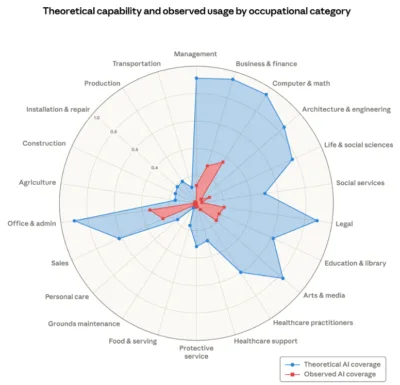
One of the most interesting findings of the study is the difference between what AI systems could theoretically do and how they are currently used in practice.
The figure below illustrates this gap across occupational categories.
Source: https://www.anthropic.com/research/labor-market-impacts
In many occupations — including education, healthcare support, and business administration — the theoretical capability of AI is relatively high, but actual usage remains significantly lower. For example:
- In education, AI could assist with preparing teaching materials, generating quizzes, or summarizing academic texts, yet many educators still use these tools only occasionally.
- In healthcare support roles, AI could help summarize patient information or assist with documentation, but regulatory and organizational barriers slow adoption.
- In office and administrative work, AI can automate document drafting or email communication, yet implementation often depends on organizational policies and digital skills.
This gap suggests that the transformation of work is still at an early stage, and that organizational factors, skills, and workplace practices play a major role in shaping AI adoption.
AI is most often used for task augmentation
Another important finding is that AI is most commonly used for augmenting individual tasks rather than replacing entire jobs. The most frequent AI-supported activities include:
- writing and editing text
- summarizing documents and reports
- generating computer code
- explaining technical concepts
- brainstorming ideas and creative concepts
- analyzing and interpreting information
These patterns indicate that AI currently functions mainly as a collaborative tool, supporting human expertise rather than fully automating professional roles.
Implications for skills and organizations
The results are particularly relevant for the goals of the NAWA DIGIT project, which focuses on understanding how people and algorithms collaborate in digital work environments.
The study highlights that the key challenge for organizations is not only adopting AI technologies but also developing the competencies that enable employees to work effectively with AI systems. These include skills such as:
- formulating effective prompts and queries
- evaluating AI-generated content
- integrating AI outputs into decision-making processes
- combining human expertise with algorithmic support
As AI tools continue to evolve, the ability to collaborate with intelligent systems will become an increasingly important component of digital competence in many professions.
The full research report is available here:
https://www.anthropic.com/research/labor-market-impacts
References
Anthropic. (2025). Labor market impacts of AI: Evidence from millions of Claude conversations. Anthropic. https://www.anthropic.com/research/labor-market-impacts
This post is part of the project “People and Algorithms in Organisations: Competences to Work in the Digital Environment” (DIGIT_People and algorithms), funded by the Narodowa Agencja Wymiany Akademickiej (Polish National Agency for Academic Exchange).
#DIGIT_NAWA #competencies #marketing #AI