




Collective blindness as a side effect of good intentions
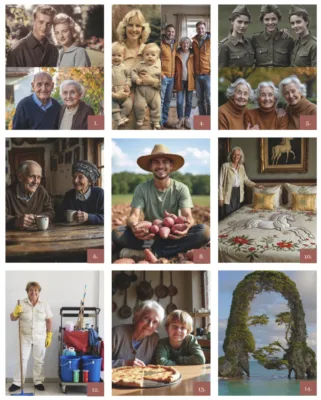
There is a kind of deception that neither intelligence nor education nor healthy scepticism can protect us from. This deception exploits not our weaknesses, but our virtues: empathy, respect for the elderly, and the desire to belong. A study by Márk Miskolczi, published in Computers in Human Behavior, sheds disturbing light on this phenomenon. An analysis of almost 9,000 Facebook users’ reactions to AI-generated images reveals what could be termed the architecture of collective self-deception. It’s not about sophisticated deepfakes or political disinformation; it’s about something much more mundane and therefore harder to detect: pictures of elderly people having coffee, lonely children waiting for birthday wishes, and faces of Christ hidden in the landscape.
The study identified five main thematic categories, the most dominant of which appeal to emotions and nostalgia, evoking empathy and compassion. Old couples celebrating an anniversary accounted for 14% of the analysed images, while scenes inviting the viewer to join them for imaginary coffee accounted for a further 10%. These proportions are no coincidence. They represent a precisely calibrated formula for engaging with our deepest emotional needs. The real power of deception lies in what happens next: the comments, the reactions, and the cascade of human kindness. The study found that inspirational messages and words of encouragement accounted for more than twenty percent of all interactions, as did birthday wishes. A significant portion of these comments comes from bots – automated accounts that simulate human reactions. Users who were sceptical of the images themselves often fell for the bots’ comments, mistaking them for genuine human reactions. In other words, even those who were critical of the visual content were taken in by the illusion of a community created by algorithms.
Miskolczi describes this as a manifestation of the so-called ‘dead internet’ theory – the hypothesis that an increasing proportion of online activity is generated by bots rather than humans. Four cognitive mechanisms work together in this process. The first is confirmation bias: images depicting values we already hold, such as respect for old age, family values, and spirituality, automatically gain our acceptance. The second is the anchoring effect, in which an initial strong emotional response can overshadow subsequent doubts or perceived inconsistencies. The third is the familiarity effect: motifs that evoke universal experiences (such as rural childhoods or intergenerational ties) resonate with our memories, thereby increasing the credibility of the message. The fourth mechanism is groupthink: when we see thousands of positive reactions, our individual scepticism seems out of place.
Religious and spiritual content plays a special role. The study found that expressions of gratitude and references to faith played significant roles in interactions. By harnessing the emotional resonance of religious beliefs, AI images can amplify their deceptive power and build trust in the authenticity of the message, even when there is no factual basis. Motifs such as the face of Jesus hidden in the landscape or an angel watching over a child appeal to something deeper than aesthetics: our need for meaning and transcendence. The study found that images referring to inter-ethnic conflicts or neglected children generated lower engagement and more sceptical reactions. Content that evokes negative emotions, such as indignation and anger, seems to activate our critical mechanisms more easily than content that appeals to nostalgia and warmth.
Miskolczi warns that, if emotional deception through AI-generated images becomes commonplace, users may begin to distrust not only digital content, but also the ethical use of AI. Without transparent detection tools and user-centric educational initiatives, the persuasive power of synthetic content could erode public trust in technological innovation itself. There is a risk that disappointment with fraud will turn into cynicism towards all things digital.
References
Miskolczi, M. (2025). The illusion of reality: How AI-generated images (AIGIs) are fooling social media users. Computers in Human Behavior, 108876. https://doi.org/10.1016/j.chb.2025.108876
This post is part of the project “People and Algorithms in Organisations: Competences to Work in the Digital Environment” (DIGIT_People and algorithms), funded by the NAWA – Narodowa Agencja Wymiany Akademickiej (Polish National Agency for Academic Exchange).
#DIGIT_NAWA #competencies #marketing #AI