




Is AI taking jobs from the young… while supporting experienced workers?
Recent analyses on the impact of artificial intelligence technologies, including systems such as GPT-4, suggest that AI does not affect all workers equally. One of the key differentiating factors appears to be age and the type of tasks performed within occupations.
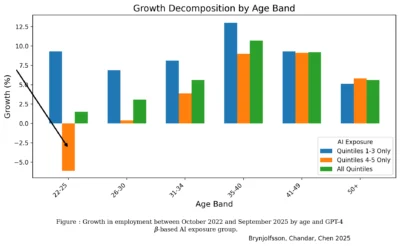
Research examining employment trends between 2022 and 2025 shows significant differences in employment growth depending on workers’ age and the level of exposure to AI technologies. The strongest contrast can be observed among the youngest employees. In the 22–25 age group, occupations with high AI exposure recorded a decline in employment, while jobs with lower AI exposure continued to show employment growth. This may indicate that many early-career roles involve routine and easily automatable tasks that are particularly vulnerable to AI-driven transformation.
However, the relationship changes in older age groups. Among workers aged 35–40, employment growth remains strong regardless of AI exposure level. Similar patterns can also be observed among employees aged 41 and above. These findings suggest that AI may increasingly function as a productivity-enhancing tool for experienced professionals rather than a direct substitute for their work.
The results highlight that the impact of AI on the labor market is not uniform. Instead of simply replacing jobs, AI appears to transform the structure of work and change which competencies are most valuable. Digital skills, adaptability, and the ability to collaborate effectively with intelligent systems may therefore become increasingly important for long-term employability.
The analysis was discussed during the International Conference on AI in Work, Innovation, Productivity and Skills 2026 organized by the OECD, in which members of the DIGIT_People and algorithms project had the opportunity to participate.
Source:
Brynjolfsson, E., Chandar, B., & Chen, R. (2025). Canaries in the coal mine? Six facts about the recent employment effects of artificial intelligence. Stanford Digital Economy Lab. https://digitaleconomy.stanford.edu/app/uploads/2025/12/CanariesintheCoalMine_Nov25.pdf
This post is part of the project “People and Algorithms in Organisations: Competences to Work in the Digital Environment” (DIGIT_People and algorithms), funded by the NAWA – Narodowa Agencja Wymiany Akademickiej (NAWA).
#DIGIT #NAWA #AI #FutureOfWork #DigitalCompetencies #LabourMarket #GPT4 #ArtificialIntelligence #WorkplaceAI #DigitalTransformation