




Redesigning Work for Human-AI Collaboration – Beyond the Automation Fallacy
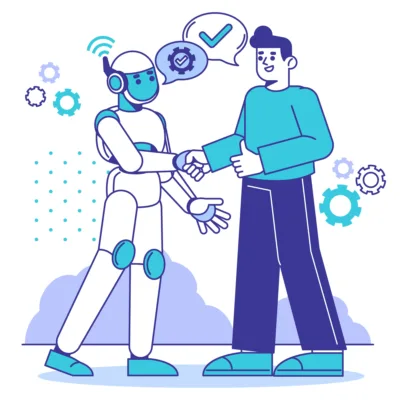
Most organisations approach AI with a simple question: “Which tasks can be automated?” Research indicates that their inquiry is misguided, primarily because of the automation trap.
A thorough MIT review of 106 experiments involving human-AI collaboration found that automation often leads to reduced overall system performance compared to well-designed collaboration. The research identified the following key areas: when complementarity succeeds; when humans currently outperform AI alone; when tasks involve content creation rather than pure decision-making; and when AI completes subtasks while humans integrate and direct.
Effective AI assistance must be as independent as possible from human judgment. A higher correlation between human and AI predictions limits the benefits of complementarity – the system works best when AI catches what humans miss, not when it reinforces existing judgment.
There are four models of human-AI work design that research identifies:
- The human-in-the-loop approach involves AI recommendations, with the final decision being made by humans at multiple checkpoints. Whilst this approach preserves expertise, it can slow processes. This is particularly beneficial in high-stakes decision-making scenarios where accountability is paramount.
- Human-on-the-loop – AI operates autonomously with human monitoring and intervention capability. Robust anomaly detection is required to alert the relevant personnel when intervention is necessary. Aviation employs this model in conjunction with autopilot systems.
- Human-above-the-loop – Humans define the strategic direction and establish boundaries, while AI implements within defined parameters. This is effective for scaled operations, but it is important to note that it also demands clear governance frameworks.
- The Centaur model is an integrated system that facilitates collaboration, with task allocation that is dynamically adjusted based on comparative advantage. Chess champion Garry Kasparov demonstrated that a combination of human expertise, machine processing power, and superior process design can outperform a strong computer alone.
Sources:
- Amershi, S., Weld, D., Vorvoreanu, M., Fourney, A., Nushi, B., Collisson, P., … & Horvitz, E. (2019, May). Guidelines for human-AI interaction. In Proceedings of the 2019 chi conference on human factors in computing systems(pp. 1-13).
- Kasparov, G. (2017). Deep thinking: Where machine intelligence ends and human creativity begins. New York: PublicAffairs.
This article is part of the project “People and Algorithms in Organisations: Competences to Work in the Digital Environment” (DIGIT_People and algorithms), funded by the NAWA – Narodowa Agencja Wymiany Akademickiej (Polish National Agency for Academic Exchange).
#DIGIT_NAWA #AI #ArtificialIntelligence #Management#Leadership #HumanAICollaboration #ComplementaryAI #AIStrategy #BusinessStrategy #DigitalTransformation #FutureOfWork #AIResearch #NAWA
Photo: Freepik