




What did we actually start doing with AI agents?
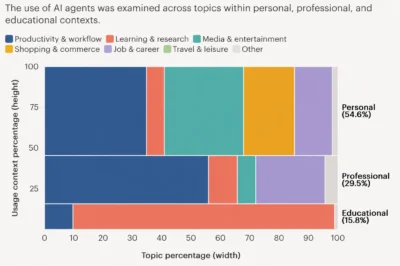
A study published recently is worth reading carefully. Jeremy Yang of Harvard Business School, along with a team at Perplexity, analysed hundreds of millions of anonymous interactions with AI agents — specifically, the Comet browser and its built-in assistant. This is one of the first attempts to capture who actually uses agent-based AI, and how – not the one announced in presentations, but the one that is used every day.
However, the most interesting thing is not the numbers themselves, but the subtle change they describe. Yang puts it simply: agents take in goals and preferences, not step-by-step instructions. In other words, we stop asking AI for answers – we start delegating tasks to it. It is a difference that seems technical, but in fact concerns how we understand our own work and our own agency.
Who are these first “customers” of delegation? As one might expect, these are primarily early adopters, residents of countries with high GDP and a high level of education, and – importantly – knowledge workers. The digital industry accounts for 28% of users. Scientists and people working in finance – 10% each. Marketing, design and entrepreneurship together – 5%. These numbers already say something: agents are most quickly taken up by those whose work consists primarily of operating with information.
And what do we use them for? Productivity and workflows – 36% of queries. Learning, courses, summarising research materials – 21%. Media and entertainment – 16%. Shopping, travelling, career – a few percent each. Yang describes it as “a second brain and a second pair of hands” – less of a personal assistant, more of a research assistant. Something that can be entrusted with tedious fragments of thinking, and not just tedious fragments of execution.
And here comes a question worth sitting with for a while. If agents become, as Yang puts it, digital collaborators rather than tools, then what does such a relationship require of us? What does it mean to work “next to” something that plans, clicks and chooses for us, though still on our behalf? When learning to delegate, aren’t we also handing over more than just the execution of a task?
Yang also signals a less visible risk: an uneven adoption rate could exacerbate existing disparities. Those who know how to work with agents gain an advantage disproportionate to the difference in skills. Human oversight remains necessary – especially where decisions are irreversible or have high stakes.
Perhaps it is worth accepting that this is not a question about the future, but about the present, which we do not yet fully understand. Because if most clicks on a website are soon to come from agents, then we are designing a world in which the first user of each interface will no longer be a human. And then the question is not whether we can use these tools – but whether we can understand what we are really doing with them.
Chart source and full story: https://www.library.hbs.edu/working-knowledge/whos-adopting-ai-agents-and-what-theyre-actually-doing-with-them
This post is part of the project “People and Algorithms in Organisations: Competences to Work in the Digital Environment” (DIGIT_NAWA), funded by the NAWA – Narodowa Agencja Wymiany Akademickiej (Polish National Agency for Academic Exchange).