



When everyone becomes good, no one is outstanding
There is a certain paradox in our expectations of AI. The tool was supposed to multiply our creative power. And it does, but for everyone. So the differences between us are blurred.
Studies published in recent months in Nature Human Behaviour and Science Advances paint a seemingly optimistic picture. People who use AI generate more ideas, explore more directions, and their work is rated as more creative than work created without the support of algorithms. On an individual level, AI acts as an amplifier, especially for those who didn’t consider themselves creative before. A novice writer can create a text with the help of AI that would have been out of reach just a year ago. A designer without years of experience can generate a visualization that looks professional.
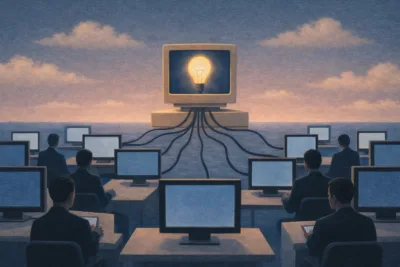
However, when we look at the collective level, the picture changes. When many people use the same AI tools, their ideas start to become similar to each other. The diversity of ideas, the ingredient that drives innovation, is decreasing.
Meincke and colleagues point to something important: AI helps those who start from a lower level the most. It raises the baseline. But it does not raise the ceiling. People who were truly outstanding before the AI era don’t become more outstanding because of it. And the difference between “good” and “outstanding” is shrinking, because the bottom has risen and the top has remained where it was.
Perhaps we are entering an era that can be called a democracy of mediocrity. A world where barriers to entry are falling, where anyone can produce content at a solid level, where “good enough” is becoming the norm. This is not an anti-utopia, but simply a change in the rules of the game. But it is worth asking what we lose in this transaction.
We are perhaps losing this strange, inefficient space in which people struggled for years with the resistance of creative matter, and thanks to this discovered paths that no one had paved before. We lose the randomness resulting from the diversity of approaches, mistakes, idiosyncrasies. When we all use the same models, trained on the same data, optimized for the same metrics, our solutions begin to converge on the same attractors.
This leads to a fundamental question: what exactly is creativity? When it comes to generating ideas, AI does it faster. But if creativity is something more, such as the ability to break conventions or express a perspective so individual that it cannot be replicated, then perhaps real creative work begins only where AI ends.
Researchers suggest that in the age of AI, the key competence is not generation, but selection. Choosing from hundreds of proposals the one that is worth keeping. Giving direction and meaning. Deciding what is important. These are skills that AI, at least for now, does not have. But do we have them? Have we learned to distinguish between “good” and “outstanding” in a world where everything looks good?
This post is part of the project “People and Algorithms in Organisations: Competences to Work in the Digital Environment” (DIGIT), funded by the NAWA – Narodowa Agencja Wymiany Akademickiej (Polish National Agency for Academic Exchange).
#AI #ArtificialIntelligence #Marketing #GPT5 #Innovation #DigitalMarketing #FutureOfWork #ResponsibleAI #Productivity #TechTrends #DIGIT #UEP #PUEB