
REWORK

Can REmote WOrking make labor maRKet more inclusive?

The project: REWORK – Can Remote Working Make Labour Market More Inclusive? supported by the National Science Centre in Poland within OPUS-25 under grant number 2023/49/B/HS4/01647

Research budget: 807.425 PLN

Implementation time: October, 1st 2024 – September, 30th 2027

Research Area: HS – Humanities, Social Sciences, and the Arts, HS4 – Individuals, institutions, markets

  • Scientific goal of the project

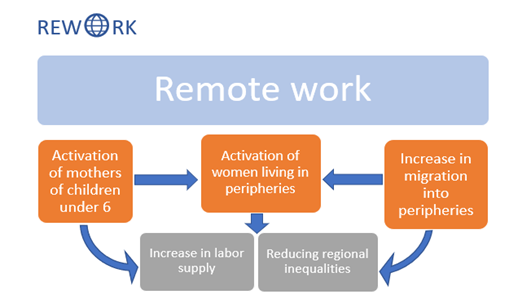
    The main objective is to assess the prospect of remote working to spur convergence in regional and local labor markets and to increase the activity rate among women. To achieve this, the project will collect new survey data to address the following inquiries: does the implementation of remote work solutions in the post-pandemic era encourage individuals aged 25-49 to relocate from urban areas to peripheral regions and motivate women with children under the age of six to increase their professional activity? Specifically, the project will investigate how remote work can mitigate geographic disparities in labor markets and enhance women’s participation in the workforce.

    The geographical focus of the project concerns selected EU countries (France, Italy, Sweden, Romania, and Poland). These countries will be selected based on their post-pandemic experiences in promoting work-from-home opportunities for mothers with young children and observations of regional migration patterns.

    The main hypothesis of the project posits that remote work can significantly impact both the migration of individuals from metropolitan areas to peripheral regions and the labor force participation rate of women. However, the extent of this effect depends on the level of state involvement in promoting remote work as a standard form of employment.

  • Importance of the project

    The COVID-19 pandemic has profoundly impacted the adoption of digital and remote work practices, leading to significant changes in societal attitudes towards this type of work. This shift has granted employees greater control over their working hours and the freedom to choose their place of residence. Moreover, it has allowed employers to tap into previously inactive or marginalized segments of the labor market, as these individuals value the flexibility of remote work and the reduction in commuting requirements. Given European markets’ aging population and labor shortages, remote work can activate the workforce, reduce social inequalities, and support local labor market development. The REWORK project aims to evaluate the influence of remote work on the activation of women, a key demographic for the labor market, and the spatial mobility of young families.

    Additionally, the project aims to examine the potential implications for regional economic growth. The newly acquired primary data will contribute novel insights that can help shape labor market policies and regional development strategies in the analyzed countries. Promoting women’s professional engagement is a priority and key objective of the EU’s economic policy. Increased female labor force participation fosters diversity and empowers women to support themselves, their families, and their communities, thereby improving living standards and reducing reliance on welfare systems. Furthermore, the technological and social changes associated with remote work can serve as drivers of regional development and mitigate the negative consequences of urbanization. Therefore, gaining a deeper understanding of the mechanisms underlying women’s inclusion into the labor market and the role of remote work in local labor market development will shed light on the broader societal benefits of the digital revolution.

  • Research concept and plan

    The project will consist of five research tasks:

    Task 1: Comparing remote working arrangements across European Union countries.

    Task 2: Designing and conducting a conjoint survey.

    Task 3: Evaluating employee motivation to reside in peripheral areas rather than metropolitan centers due to remote work.

    Task 4: Investigating mothers’ motivation to increase their workforce participation through remote work.

    Task 5: Determining whether remote work has the same potential to activate women in peripheral regions as in metropolitan areas.


  • Methodology

    Implementing the research project involves gathering both primary and secondary empirical material and using quantitative and qualitative data analysis methods. The main data source will be a survey based on a conjoint experiment. The survey will be conducted in selected EU countries (France, Italy, Sweden, Romania, Poland, and partially in the Netherlands).

  • Publications

    1. Beata Woźniak-Jęchorek, Sławomir Kuźmar, & David Bole (online 2025, in print 2026). Will Remote Work Drive a New Wave of Suburbanisation in Poland? Analysing the Relocation Preferences of Polish Office Employees, Applied Geography, 186, 103848.
    2. Beata Woźniak-Jęchorek & Sławomir Kuźmar (2025). Remote Work in Poland: Socio-Economic Drivers and Preferences, Working paper under review
    3. Sławomir Kuźmar (2026). Relocation Preferences in the Era of Work From Home: Theoretical FrameworkEkonomia i Prawo. Economics and Law. Vol. 25, no. 1, pp. 23- 42. DOI 10.12775/EiP.2026.2.
    4. Wiktoria Domagała & Julia Jastrząbek (2025). Advancing Gender Equality through EU Law: A Comprehensive Review, Working paper under review
    5. Beata Woźniak-Jęchorek (2025). Niedobory siły roboczej i kompetencji na europejskim rynku pracy w erze digitalizacji: trendy, prognozy, wyzwania
      w: Bezpieczeństwo społeczne i gospodarcze w perspektywie krajowej i europejskiej, Studia BAS, 1(81) 2025, s. 77-102,
    6. Beata Woźniak-Jęchorek (2025). Praca z domu jako instrument aktywizacji kobiet na europejskim rynku pracy – wnioski z przeglądu danych, Working paper under review
  • Consultations

    Other consultations:

    1. Online consultations with James Druckman (University of Rochester, USA), April 9, 2025 (study on women) and January 11, 2026 (relocation).
    2. Online consultations with Yana van der Meulen Rodgers (Rutgers University, USA), February 5, 2026 (study on women)
    3. Participation in the CBP Regional and Entrepreneurship Webinar, organized by the Centre for Business Prosperity (Aston Business School, Aston University, Birmingham, UK), including a presentation of the research concept entitled “Relocation Intentions in the Remote Work Era: Evidence from Hybrid Choice Model Approach”(Sławomir Kuźmar), March 20, 2026.
    4. Consultations at Montpellier Business School during International Week, March 16–20, 2026 (Beata Woźniak-Jęchorek).
    5. Organization of a special session: “Gender, Labour, and Technological Changes: Feminist and Heterodox Perspectives on Changing Labour Markets” at the 38th EAEPE Annual Conference 2026 in Lausanne (Switzerland), Global Transformations of Labour, September 9–11, 2026.
  • Conferences

    1. Sławomir Kuźmar, Preferencje dotyczące pracy zdalnej a decyzje o relokacji: konceptualizacja teoretyczna, VIII Konferenca naukowa z cyklu Instytucje w teorii i praktyce, Toruń, 11-12 września 2025
    2. Beata Woźniak-Jęchorek, Conjoint survey experiment: Empowering Women Through Remote Work, 37th Annual EAEPE Conference, Athens, 24-26 September 2025
    3. Sławomir Kuźmar, Remote Work and Relocation Preferences: A Theoretical Conceptualization, 37th Annual EAEPE Conference, Athens, 24-26 September 2025
    4. Beata Woźniak-Jęchorek, Michał Pilc, Sławomir Kuźmar, Wiktoria Domagała, Julia Jastrząbek, Atrakcyjność pracy zdalnej wśród matek. Wyniki pilotażu we Francji, Polsce, Rumunii, Szwecji i Włoszech, XI Kongres Ekonomistów Polskich, 4-5 grudnia 2025 r.
    5. Sławomir Kuźmar, From Core to Periphery? Assessing Remote Work’s Potential to Rebalance EU Regional Development, ECOS Economic Competitiveness and Sustainability Conference, Brno, March 26-27, 2026
  • Pre-registration

    The study was preregistered on February 12, 2026, at AsPredicted (Wharton Credibility Lab, University of Pennsylvania).

  • Contact

    Beata Woźniak-Jęchorek –  beata.wozniak-jechorek@ue.poznan.pl

    Michał Pilc – michal.pilc@ue.poznan.pl

    Slawomir Kuźmar – slawomir.kuzmar@ue.poznan.pl

    Julia Jastrząbek – julia.jastrzabek@ue.poznan.pl

    Wiktoria Domagała – wiktoria.domagala@ue.poznan.pl 

This site uses cookies to deliver services in accordance with this Cookie Policy.
You can specify the conditions for storage or access cookies on your browser or the configuration of the service.