




Dr hab. Milena Ratajczak-Mrozek, prof. UEP, moderated the session during the 6th Scientific Seminar the Polish Scientific Marketing Society
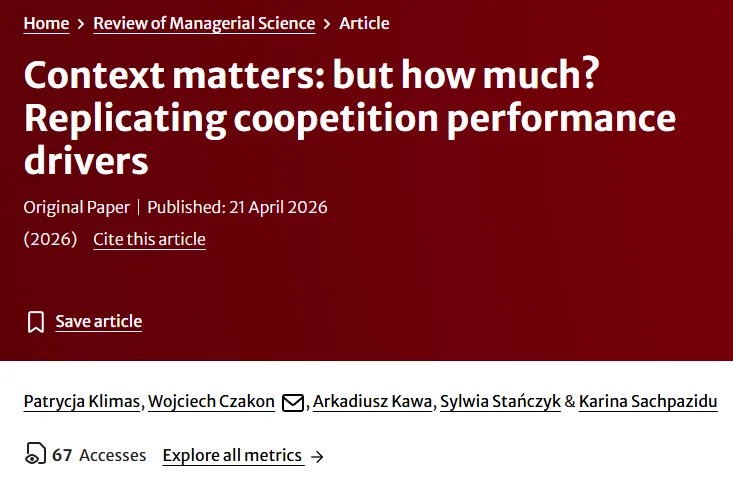
PhD Arkadiusz Kawa, Prof. PUEB, together with researchers from the Wroclaw University of Economics and Business (Prof. Patrycja Klimas, PhD Sylwia Stańczyk, Prof. WUEB), Jagiellonian University (Prof. Wojciech Czakon), and the University of Warsaw (Karina Sachpazidu, PhD), has published an article entitled “Context matters: but how much? Replicating coopetition performance drivers” in Review of Managerial Science (Impact Factor: 9.6).
The article addresses the issue of coopetition, understood as the simultaneous cooperation and competition between firms, with particular emphasis on the factors shaping performance outcomes derived from coopetitive relationships. The study is designed as a quasi-replication of earlier research conducted among manufacturing firms and transfers its assumptions to a substantially different sectoral context: creative industries. Based on data collected from 916 firms operating in creative sectors, the authors examine the extent to which strategic, relational, and behavioural attributes of coopetition influence coopetition performance, and whether mechanisms previously identified in manufacturing remain valid in a different industry setting.
The findings confirm the relevance of most previously identified coopetition-performance mechanisms. The authors show that the paradoxicality of coopetition strategy, the strength of coopetitive relationships, trust, and investment-oriented behaviours among coopetitors positively affect coopetition performance. At the same time, the study confirms the negative effects of the dynamics of coopetition strategy and asymmetry in coopetitive relationships. The research also reveals important contextual nuances specific to creative industries: competition intensity and relationship formality are not statistically significant drivers of coopetition performance, while the impact of tensions in coopetitive relationships differs from that observed in manufacturing-based research.
The article makes an important contribution to coopetition theory and to the broader debate on replication in management research. The authors demonstrate that some coopetition mechanisms are relatively robust across industry contexts, whereas others depend on sector-specific conditions. In doing so, the study refines the boundaries of generalisability in coopetition research and shows that coopetition is neither fully context-independent nor entirely context-dependent. The findings also provide practical implications for managers, highlighting the importance of trust, relationship strength, investments, and the ability to manage the paradoxical nature of cooperation with competitors.
The article is available at: https://doi.org/10.1007/s11846-026-01022-z