


.
12th AIB-CEE Chapter Annual Conference 2026
Central and Eastern Europe in Transition Again? Rethinking International Business in a Changing World
21-23 September 2026
Poznań University of Economics and Business
Institute of International Business and Economics


Keynote Speakers (AIB Fellows)

Sarianna Lundan
Professor of International Business at Aalto University School of Business. Before coming to Aalto she held the Chair in International Management and Governance at the University of Bremen in Germany. She received her PhD from Rutgers University (US), and has held prior appointments at the University of Reading (UK) and at Maastricht University (The Netherlands). She has participated extensively in the work of UNCTAD and served briefly as a Senior Economic Officer there. She has also worked on diverse policy-related projects for the World Bank, OECD and European Commission. She is a Fellow of the Academy of International Business (AIB) and the European International Business Academy (EIBA) and recently served as the Dean of the EIBA Fellows. She was President of EIBA in 2013 hosting the 39th annual EIBA conference in Bremen and she is currently President-Elect of AIB.

Alvaro Cuervo-Cazurra
Alvaro Cuervo-Cazurra (Ph.D. MIT) is the CEM Professor of Global Sustainability at Northeastern University. He is a global strategy scholar interested in understanding how context affects value creation, especially in emerging markets. His main research interest is global strategic management, in which he analyzes how institutions influence internationalization and firm performance. His secondary line is global sustainable governance, in which he studies how ownership and incentives influence sustainability and societal value. He is a Fellow of the AIB and received an honorary doctorate from Copenhagen Business School.

Ari Van Assche
Ari Van Assche (University of Hawaii at Manoa, Ph.D) is Full Professor in international business and director of the International Institute of Economic Diplomacy at HEC Montreal, Canada and Visiting Professor at the University of Reading
He teaches and does research at the intersection of international business, global value chains, and public policy. He is the Edit-in-Chief of the Journal of International Business Policy and Associate editor of the Transnational Corporations Review, as well as editorial review board member of leading IB journals. He is also a Fellow of the AIB.
He teaches and does research at the intersection of international business, global value chains, and public policy. He is the Edit-in-Chief of the Journal of International Business Policy and Associate editor of the Transnational Corporations Review, as well as editorial review board member of leading IB journals. He is also a Fellow of the AIB.
Business Keynote

Dawid Jakubowicz, CEO Kulczyk Investments
Dawid Jakubowicz is the CEO of Kulczyk Investments and an executive with international operational experience in building value across companies in the chemical, mining, energy, automotive, and new technology sectors.
He has been with the Kulczyk Investments Group since 2010, where he oversees and develops the global investment portfolio.
From 2018 to 2023, he served as President of the Management Board of CIECH S.A. (now Qemetica S.A.) – a major chemical group headquartered in the European Union, at the time listed on two stock exchanges, employing more than 3,800 people and operating nine production plants across six business units, including soda, salt, crop protection, glass and silicates, and polyurethane foams. During his tenure as President of the Management Board, the company successfully implemented a strategy that led to a significant increase in cash flow generation. Through consistent management focused on operational efficiency and on building a performance-driven and team-oriented corporate culture, CIECH achieved historically record financial results in 2022.
Earlier in his career, he worked at the international firm KPMG Audit, where he was responsible for auditing standalone and consolidated financial statements of entities from various industries.
Since 2014, he has been a licensed statutory auditor registered with the Polish Chamber of Statutory Auditors. He completed the Program for Leadership Development (PLD) at Harvard Business School in Boston and the Stanford Executive Program at Stanford University. He holds an MBA from the Poznań University of Economics and Business and Georgia State University. He is a graduate of the Faculty of Economics at the Poznań University of Economics and Business.
He has been with the Kulczyk Investments Group since 2010, where he oversees and develops the global investment portfolio.
From 2018 to 2023, he served as President of the Management Board of CIECH S.A. (now Qemetica S.A.) – a major chemical group headquartered in the European Union, at the time listed on two stock exchanges, employing more than 3,800 people and operating nine production plants across six business units, including soda, salt, crop protection, glass and silicates, and polyurethane foams. During his tenure as President of the Management Board, the company successfully implemented a strategy that led to a significant increase in cash flow generation. Through consistent management focused on operational efficiency and on building a performance-driven and team-oriented corporate culture, CIECH achieved historically record financial results in 2022.
Earlier in his career, he worked at the international firm KPMG Audit, where he was responsible for auditing standalone and consolidated financial statements of entities from various industries.
Since 2014, he has been a licensed statutory auditor registered with the Polish Chamber of Statutory Auditors. He completed the Program for Leadership Development (PLD) at Harvard Business School in Boston and the Stanford Executive Program at Stanford University. He holds an MBA from the Poznań University of Economics and Business and Georgia State University. He is a graduate of the Faculty of Economics at the Poznań University of Economics and Business.

Invited Speakers

Agnieszka Chidlow
Agnieszka (Aggie) Chidlow is Professor of International Business at the University of Birmingham (United Kingdom) and Chair of Responsible Research in Business and Management (RRBM), the leading global network dedicated to inspiring, recognising, and advancing credible and socially relevant scholarship in business and management. She has held academic and visiting positions at leading institutions across Europe, North America, Asia, and the Middle East.
Her research spans international business strategy, location choices, research methodology, and the sustainability of international business activity — and she is a leading advocate of responsible research and management education to support the 17 UN SDGs. She completed a secondment with the Principles for Responsible Management Education (PRME), contributing to research and working groups at the intersection of scientific scholarship and management education. She has an extensive, methodologically focused cross-country research portfolio, has published in leading international business and management journals, and is a co-founding member of the AIB Research Methods - Shared Interest Group.
Aggie leads RRBM's global initiatives through its strategic partnerships with the Association to Advance Collegiate Schools of Business (AACSB) and the European Foundation for Management Development (EFMD), serves on several editorial boards, and is an active contributor to debates on research assessment reform, the role of business schools in society, and the alignment of scholarly incentives with broader public value. As Chair of RRBM, she leads the organisation's global strategy, governance, and engagement — including its annual RRBM Responsible Research Symposium series and RRBM's participation in the PRME Responsible Management Education (RME) Week. Through her innovative thinking and commitment to genuine collaboration, she was the first scholar that firmly placed the international business discipline within the PRME community since the 2024 PRME Global Forum.
Her research spans international business strategy, location choices, research methodology, and the sustainability of international business activity — and she is a leading advocate of responsible research and management education to support the 17 UN SDGs. She completed a secondment with the Principles for Responsible Management Education (PRME), contributing to research and working groups at the intersection of scientific scholarship and management education. She has an extensive, methodologically focused cross-country research portfolio, has published in leading international business and management journals, and is a co-founding member of the AIB Research Methods - Shared Interest Group.
Aggie leads RRBM's global initiatives through its strategic partnerships with the Association to Advance Collegiate Schools of Business (AACSB) and the European Foundation for Management Development (EFMD), serves on several editorial boards, and is an active contributor to debates on research assessment reform, the role of business schools in society, and the alignment of scholarly incentives with broader public value. As Chair of RRBM, she leads the organisation's global strategy, governance, and engagement — including its annual RRBM Responsible Research Symposium series and RRBM's participation in the PRME Responsible Management Education (RME) Week. Through her innovative thinking and commitment to genuine collaboration, she was the first scholar that firmly placed the international business discipline within the PRME community since the 2024 PRME Global Forum.

Ilan Alon
Ilan Alon is Professor of Economics and Business at Ariel University, Israel, and Professor of Strategy and International Marketing at the University of Agder, Norway. He is recognized globally for his expertise in international business, with a focus on emerging markets, franchising, and international strategy.
He has held numerous academic positions, including as the Cornell Chair Professor of International Business and the Founding Director of The China Center at Rollins College, USA. Alon also served as a visiting professor at prestigious institutions worldwide, including the University of International Business and Economics (UIBE) in China, Georgetown University, Harvard University, Copenhagen Business School, and the Higher School of Economics in Russia.
Prof. Alon is the Editor-in-Chief of the International Journal of Emerging Markets and has served on the editorial boards of many leading academic journals. His research has been widely published in top-tier journals such as the Harvard Business Review, Journal of World Business, Global Strategy Journal, Management International Review, and many others.
He has held numerous academic positions, including as the Cornell Chair Professor of International Business and the Founding Director of The China Center at Rollins College, USA. Alon also served as a visiting professor at prestigious institutions worldwide, including the University of International Business and Economics (UIBE) in China, Georgetown University, Harvard University, Copenhagen Business School, and the Higher School of Economics in Russia.
Prof. Alon is the Editor-in-Chief of the International Journal of Emerging Markets and has served on the editorial boards of many leading academic journals. His research has been widely published in top-tier journals such as the Harvard Business Review, Journal of World Business, Global Strategy Journal, Management International Review, and many others.

Matt Raskovic
Matt Raskovic obtained his PhD from the University of Ljubljana, Slovenia and is now an associate professor of international business & strategy at Auckland University of Technology in New Zealand. He is also a guest professor at Zhejiang University in China (PIEGL Master’s program) and an Adjunct Professor at the School of Economics and Business, University of Ljubljana, Slovenia. Prior to moving to New Zealand, Matt was a Fulbright Fellow at Harvard University, FAS Sociology (2017). Matt started as an Executive Board member of the AIB-CEE chapter and was Co-Chair of the 2017 AIB-CEE chapter conference in Ljubljana, Slovenia. He was Vice-President Marketing at the Australia and New Zealand International Business Academy (2020-2023) has also served as Vice-President of Digital Communications within the AIB Teaching & Education SIG. He serves as AIB Vice President for Administration.

Noemi Sinkovics
Noemi Sinkovics is Professor of Sustainable and Responsible Business and Associate Dean for Ethics, Responsibility and Sustainability at Newcastle University, United Kingdom and Visiting Professor at the University of Vaasa’s InnoLab, Finland. She received her PhD from the University of Manchester, United Kingdom, and has previously held positions at the University of Glasgow, the University of Auckland, and the University of Manchester. Her research focuses on how businesses can balance social, environmental, and economic objectives, with particular interests in entrepreneurship, global value chains, business model innovation, and sustainable and regenerative development. She has extensive editorial experience and methodological expertise, particularly in qualitative and mixed methods. She is Deputy Editor at the European Management Journal, Associate Editor at Critical Perspectives on International Business, and serves on several editorial review boards.

Tony Fang
Tony Fang, PhD, is Professor of Business Administration at Stockholm Business School (SBS) of Stockholm University.
Tony Fang received his PhD and Licentiate of Economics in Industrial Marketing, Industrial Economy, Linköping University, Sweden (1999, 1997) and his Master of Science (MSc) and Bachelor of Science (BSc) in Naval Architecture and Ocean Engineering from Shanghai Jiao Tong University, China (1987, 1984).
Tony Fang worked earlier at the Institute of International Business (IIB), Stockholm School of Economics (SSE) where he was Director for the SSE's International Graduate Program (IGP). He was a visiting scholar in the Department of Political Science at Massachusetts Institute of Technology (MIT) (1998; Host and mentor Professor Lucian W. Pye).
Tony Fang teaches at Bachelor, Master, and PhD levels and in executive programs. He supervises university students' graduation theses work every year. He has been supervisor for a number of doctoral students at SBS. Currently, he is the principal supervisor for a doctoral research on Volvo Cars under Chinese ownership.
Tony Fang currently serves as an Area Editor of the Journal of International Business Studies (JIBS), the flagship journal of the Academy of International Business (AIB). His area of scope includes culture; cross-cultural management/leadership (communication/innovation; negotiation; paradox and Yin‑Yang thinking; emerging markets; non‑Western paradigms; Global South vs. Global North; global sustainability; and futurism. Tony Fang speaks on behalf of the JIBS Editorial Board.
Tony Fang received his PhD and Licentiate of Economics in Industrial Marketing, Industrial Economy, Linköping University, Sweden (1999, 1997) and his Master of Science (MSc) and Bachelor of Science (BSc) in Naval Architecture and Ocean Engineering from Shanghai Jiao Tong University, China (1987, 1984).
Tony Fang worked earlier at the Institute of International Business (IIB), Stockholm School of Economics (SSE) where he was Director for the SSE's International Graduate Program (IGP). He was a visiting scholar in the Department of Political Science at Massachusetts Institute of Technology (MIT) (1998; Host and mentor Professor Lucian W. Pye).
Tony Fang teaches at Bachelor, Master, and PhD levels and in executive programs. He supervises university students' graduation theses work every year. He has been supervisor for a number of doctoral students at SBS. Currently, he is the principal supervisor for a doctoral research on Volvo Cars under Chinese ownership.
Tony Fang currently serves as an Area Editor of the Journal of International Business Studies (JIBS), the flagship journal of the Academy of International Business (AIB). His area of scope includes culture; cross-cultural management/leadership (communication/innovation; negotiation; paradox and Yin‑Yang thinking; emerging markets; non‑Western paradigms; Global South vs. Global North; global sustainability; and futurism. Tony Fang speaks on behalf of the JIBS Editorial Board.
Organizers
Organizing Commitee










Key Dates
Submission system: https://meetings.aib.msu.edu/cee/2026/
Short Paper/Full Paper/Panel Proposal Submission Deadline: 21.06.2026 (extended deadline)
Short Paper/Full Paper/Panel Proposal Decisions Announcement: 22.06.2026
Conference Workshops Application Deadline: 31.08.2026 (extended deadline)
Early-bird Registration Deadline: 17.07.2026
Regular Registration Deadline: 14.08.2026
Late Registration Deadline: 11.09.2026
Submissions
Submissions & Guidelines
Conference submissions must be made by 21.06.2026 (extended deadline)
Workshop submissions must be made by 31.08.2026 (extended deadline)
- Please submit your short papers/full papers/panel proposals via: https://meetings.aib.msu.edu/cee/2026/
- Submissions for the Paper Development Workshops and Doctoral/Faculty Developement Workshops can be made:
-JIBS-JIBP PDW: https://form.jotform.com/261185467355161
-Doctoral/Junior Faculty Consortia: https://form.jotform.com/261194078967168
If you have any questions or face any difficulties related with the submission and/or review processes, contact:
aib-cee2026@konf.ue.poznan.pl
Each author should not make more than 3 submissions
Paper Submission Guidelines
Short papers (similar to extended abstracts, or SMS-style submissions) can be submitted to the Conference. Short papers should be between 1000 and 3000 words inclusive of all materials, including appendices and references. They should include an abstract, introduction, theoretical background, methodology, results, discussion (with theoretical contribution, managerial and/or policy implications and future research directions – if applicable), and references. Short papers might report work-in-progress research whose results may not be complete upon submission, however the results are expected to be presented at the conference.
Full papers must be fewer than 10,000 words inclusive of all materials, including appendices and references. Papers exceeding these limits will be returned to the authors.
References are required and must be included in the submission file. Please submit your proposal in PDF format or MS Word and make sure all information which might reveal authors’ identity and affiliation are removed from the submission.
All submissions must include an abstract of 150-200 words, and should conform to the JIBS style guide, available here: https://www.palgrave.com/gp/journal/41267/authors/artwork-guidelines
Each manuscript must state, on its front page at the top right, the requested Track (number and title).
All manuscripts must be in English.
The document must be stripped of all identifying information: None of the pages (not even the first page) should list any author information and the File Properties for the documents should be cleaned to remove identifying information.
Panel Submission Guidelines
Panel Discussion Sessions are forums for issues of contemporary interest to IB scholars. Panels are organized as a single submission by a panel chair around a common theme. Panels may have various formats –roundtable discussions, keynote and discussion with senior scholars not normally involved in the AIB, pro and con debates, or professional development workshops.
We expect all panel submissions to ensure fair gender representation and reflect our dedication to diversity and inclusion. They must be structured to facilitate interactivity.
- A panel session must allocate substantial time to a genuine interchange among the panelists, and/or between panelists and the audience. When designing the panel, keep in mind you will have 75 minutes for the session.
- To facilitate sufficient time for genuine interchange and discussion, panels should constitute no more than 4 people presenting on a specific theme, and the total time for presentations should not exceed 2/3 of the total session time (i.e., 50 mins for a 75-minute session).
- Panel submissions that simply feature a series of paper presentations will be rejected.
- We recommend the following approach when developing the panel:
- Identify a theme and create a detailed abstract that summarizes the theme and issues the panel aims to address;
- recruit scholars or other experts and request they identify thematic topics that are consistent with the abstract;
- based on the identified topics, create a program that is coherent, meaningful and which follows a logical order of the expected presentations and discussion;
- request panelists to present and discuss their topics accordingly;
- request each panelist to formulate at least two questions that they would like to ask one or more other panelists about their topic, during the panel discussion;
- the chair or other participant might serve as moderator or timekeeper to keep the panel on track and ensure sufficient time for substantive interaction and discussion.
This approach is intended to create a panel that features substantial discussion and Q&A among the panelists and with the audience, comprising a significant portion of the total session time.
Panel proposals should be no more than 3000 words inclusive of all materials, and must be submitted by the panel chair. All panel proposals must include:
- A Title Page that includes the panel name, the session format (e.g., pro and con debate, moderated roundtable discussion, keynote and commentary, professional development workshop, etc.) and the panel participants.
- The name, affiliation, email address, and role of each participant in the panel (chair, discussant, and/or panelist). All panelists listed in the submission must appear and present at the conference. Each panel must specify a chair. A second chair and/or a discussant are optional.
- A detailed overview of the main issue(s) addressed or arguments to be made in the panel.
- Any special technical setup that the panel may require (only if beyond a standard video conferencing setup: i.e., need for breakouts, polling, and other advanced features). The feasibility of any special requirements will be part of the evaluation criteria.
- Copies of emails or letters from each participant stating they agree to participate in the panel if the proposal is accepted. Failure to include these confirmations will count against the proposal.
Pre-Conference Workshops
21 September 2026
An important aspect of the AIB-CEE mission is to support scholars at different levels of their academic development in the publication process and research planning. Therefore, in cooperation with our distinguished partners we are pleased to organize several developmental sessions :
The Journal of International Business Policy (JIBP) and Journal of International Business
Studies (JIBS) will organize a joint Paper Development Workshop (PDW) in Poznań,
Poland, as part of the pre-conference program for the 2026 AIB-CEE Chapter Meeting. We
invite interested scholars to submit their papers and paper proposals.
Who is This Event For?
The paper development workshop gives scholars the opportunity to receive developmental
feedback on their research from the editorial teams of JIBP and JIBS. We invite scholars
to submit a paper or research idea that they would like to discuss with our editors. We
particularly encourage submissions by young scholars who are unfamiliar with the
publication process, from established scholars who want to conduct a policy turn in their
international business research, and from scholars who are trained in disciplines less
commonly associated with the field of international business (e.g., economic geography,
development studies, political science, economics) but are interested in targeting our
journal.
How is This Event Structured?
The workshop will consist of two parts. During the first 90 minutes, Sarianna Lundan (AIB
President-Elect, JIBP inaugural editor-in-chief) will provide an overview of AIB’s journal
portfolio and present AIB code of ethics in research and publishing. Ari Van Assche (JIBP
editor-in-chief) and Tony Fang (JIBS Area Editor) will discuss the manuscript review
process in AIB journals and provide pointers on how to conduct high-quality research on
international business. During the next 90-minutes (after a coffee break), based on the submission preferences of
participants, they will be assigned to separate tracks with either Tony Fang and Alvaro
Cuervo-Cazurra (AIB Fellow, JIBS Consulting Editors Board member), or Ari Van Assche
and Sarianna Lundan for JIBP-related submissions. The editors will provide individualized
advice and feedback on their papers and research. JIBP and JIBS editors will also allocate
time to provide insights into their personal publication strategies.
How Can I Submit a Paper?
To participate in the JIBP-JIBS PDW, we invite scholars to upload (1) paper proposals
(min. a paragraph and max. 4000 words) or (2) full papers (max. 10,000 words) through: https://form.jotform.com/261185467355161. It is important to highlight at the top of the title page that you are
submitting to the JIBP-JIBS PDW, and whether your target journal is JIBP or JIBS.
Authors of accepted full papers will have the opportunity to receive detailed comments on
their manuscript from the workshop faculty team. Authors of accepted paper proposals
will have the chance to discuss their research ideas with a view to further developing their
manuscripts.
The deadline for submissions is 31.08.2026 (extended deadline), in the authors’ time zone.
What Should I Do if My Paper is Accepted?
Submitting authors will be notified of the results of the review process,
and will need to confirm their participation in the PDW.
Please note that authors will need to register for the AIB-CEE conference in order to
participate in the JIBP-JIBS PDW. Also note that other faculty development
workshops will run in parallel with the JIBP-JIBS PDW. It will therefore not be
possible to participate in the JIBP-JIBS PDW if you are participating in any of the other
pre-conference events.
Who do I contact if I have questions?
If you have any questions about our PDW, please contact Ari Van Assche (JIBP editor-in-chief): ari.van-assche@hec.ca, or Tony Fang (JIBS Area Editor), tony.fang@sbs.su.s
1. AIB CEE Chapter Doctoral Colloquium:
Chair: Matt Raskovic, Auckland University of Technology, New Zealand (contact:
matt.raskovic@aut.ac.nz)
Submission date: 31.08.2026 (extended deadline)
Submission process: https://form.jotform.com/261194078967168
Submission format:
five-page PhD proposal (excl. references) outlining the following
• Title/working title of PhD research project
• 300-word introduction about the candidate’s background, personal motivation for
pursuing a PhD, stage of PhD journey and personal motivation for the PhD topic
• Main research question and sub-questions
• Brief literature review and clearly articulated theoretical gap motivating the research
• Overview of key theoretical framework(s) (i.e., which theories are you using and why)
• Research design (i.e., data, methodology, operationalisation, level of analysis)
• Overview of empirical phenomenon (if applicable)
• Key contributions (i.e., theoretical contributions, managerial implications, policy
implications, future research directions)
2. AIB CEE Chapter Junior Faculty Consortium:
Chair: Noemi Sinkovics, Newcastle University, UK (contact:
noemi.sinkovics@newcastle.ac.uk)
Submission date: 31.08.2026 (extended deadline)
Submission process: https://form.jotform.com/261194078967168
Submission format:
• three-page motivational statement (i.e., personal motivation for attending the JFC,
specific questions you are seeking answers to, your research identity and types of
research you are doing)
• Full academic CV (incl. education background, teaching, research and academic
citizenship
Conference Registration
Program Overview
JIBS-JIBP Paper Development Workshop
AIB CEE Chapter Doctoral Colloquium
AIB CEE Chapter Junior Faculty Consortium
AIB-CEE Board Meeting
Conference Opening Plenary
Welcome Reception
Plenary sessions
Parallel sessions
Gala Dinner
Plenary sessions
Parallel sessions
Meet-the-Editors session
Conference summary
Conference Tracks
Geopolitical tensions, strategic rivalry, and growing fragmentation are reshaping the international business environment in profound ways. This track welcomes contributions on how sanctions, security concerns, regulatory uncertainty, and shifting patterns of international cooperation affect firms, industries, and governments. Particular attention may be paid to nearshoring, friendshoring, and regionalisation, as well as to the changing role of Central and Eastern Europe in the evolving global political economy. The track encourages contributions that go beyond descriptive accounts and are aimed at developing new conceptual lenses or theoretical approaches on how geopolitical fragmentation reshapes firm behaviour, state–firm relations (industrial policy, security-driven regulation, and the emergence of new forms of state capitalism shaping international business decisions), and global value chains (configurations, governance structures, and patterns of value capture).
Keywords: geopolitics; fragmentation; nearshoring and friendshoring; sanctions and regulation; regionalisation; CEE in the global political economy
Central and Eastern Europe has long served as an important context for theorizing institutional change and its business implications. This track focuses on how evolving formal and informal institutions shape firm strategies, cross-border collaboration, and patterns of competitiveness across the region. Contributions may address the renewed role of the state in industrial policy, innovation support, and sustainability governance, as well as the substantial institutional heterogeneity across different parts of CEE. The track also explicitly invites reflection on whether, and under what conditions, CEE can still serve as a distinctive laboratory for international business theory development in a period marked by new geopolitical, economic, and social pressures.
Keywords: institutions; institutional change; informal institutions; state role and industrial policy; CEE diversity; IB theory
This track examines the changing sources of competitiveness in Central and Eastern Europe in light of global restructuring, technological change, and sustainability pressures. It welcomes papers on functional and technological upgrading in global value chains, sectoral transformation, and the evolving balance between FDI-led and domestic-led growth models. Contributions may focus on industries such as automotive, electronics, IT, pharmaceuticals, agriculture, and other sectors undergoing substantial reconfiguration. The track also encourages research on the resilience and vulnerability of regional clusters, as well as on the strategic implications of the energy transition and the emergence of green industrial development paths in CEE.
Keywords: competitiveness; upgrading; global value chains; sectoral transformation; regional clusters; green industrial transition
How firms from Central and Eastern Europe expand abroad, develop capabilities, and achieve international performance remains a central question for IB scholarship. This track invites submissions on the internationalisation of CEE firms, with a particular focus on export strategies, outward foreign direct investment, springboarding, and the role of alliances, acquisitions, and partnerships in cross-border growth. It also welcomes research on learning from foreign markets, capability development under resource constraints, and the business models of emerging CEE multinationals and internationally active entrepreneurial firms. Conceptual and empirical contributions are encouraged, especially those that deepen our understanding of how CEE firms compete and grow internationally. Papers about non-CEE firms are also welcome if they focus on the above-mentioned topics.
Keywords: internationalisation; CEE firms; export strategies and OFDI; capabilities; international entrepreneurship; firm performance
In an era of geopolitical fragmentation and technological disruption, innovation increasingly depends on collaboration across organizational, sectoral, and national boundaries. This track addresses the role of innovation and collaborative innovation models in international business, with particular attention to the CEE context. It welcomes studies on open innovation across borders, innovation cooperation, trust-building, and the development of cross-sector and cross-border ecosystems. Contributions may explore the internationalisation of R&D, the conditions that support or hinder collaborative innovation, the role of digital platforms in enabling cross-border innovation, and the challenges faced by firms operating in dependent market economies. The track particularly encourages work that bridges firm-level innovation strategies with institutional, regional, and ecosystem-level dynamics in international settings.
Keywords: innovation; open innovation; innovation ecosystems; R&D internationalisation; trust and collaboration; dependent market economies
Digital transformation is reshaping how firms internationalize, compete, and organize across borders. This track focuses on the implications of digitalisation, artificial intelligence, and platform-based business models for international business strategies and operations. Relevant topics include AI adoption, automation, digital capabilities, organisational change, and digitally enabled internationalisation. Particular attention may also be paid to data governance, cybersecurity, digital regulation, and the opportunities and constraints created by platformisation. The track further welcomes studies on digital divides within and across CEE economies and their implications for firms’ international competitiveness.
Keywords: digitalisation; artificial intelligence; platformisation; digital internationalisation; cybersecurity and data governance; digital divides
Sustainability and green transformation are becoming central concerns for firms operating across borders. This track invites contributions on ESG adoption in MNEs and SMEs, sustainable supply chains, circular economy models, and the policy frameworks supporting green transition. It also encourages studies on climate risks, energy security, and the strategic responses of firms to environmental and social pressures in international markets. Special attention may be paid to the interaction between sustainability goals and internationalisation processes, including responsible internationalisation, social sustainability, and the changing expectations of stakeholders across borders.
Keywords: sustainability; ESG; green transition; sustainable supply chains; climate and energy risks; responsible internationalisation
Financial dynamics remain a key part of economic transformation in Central and Eastern Europe and beyond. This track welcomes research on financial stability, crisis response, firm-level and sovereign risk, and the role of financial institutions in supporting international business activity. Relevant topics include foreign exchange exposure, inflation, monetary dynamics, investment financing, and the development of capital markets under changing macroeconomic conditions. Contributions that connect international finance with broader processes of structural adjustment, competitiveness, and resilience are particularly encouraged, especially in contexts marked by volatility, external shocks, and evolving institutional frameworks.
Keywords: international finance; financial stability; FX and inflation risk; sovereign and firm-level risk; capital markets; economic transformation; international capital flows, international investment, international financing
Relations between Central and Eastern Europe and non-European partners are gaining new strategic relevance in an increasingly multipolar world economy. This track explores business and economic ties between CEE and China, India, ASEAN countries, Latin America, the Middle East, and other emerging markets. It welcomes research on trade, investment, cooperation frameworks, and competitive dynamics involving both traditional and emerging international players. Particular attention may be given to China–CEE relations, including the Belt and Road Initiative, as well as to the strategic role of CEE as a bridge between the European Union and emerging regions.
Keywords: China-CEE relations; emerging markets; Global South; trade and investment; multipolar competition; CEE as a bridge
National and regional business environments continue to shape the opportunities and constraints faced by internationally active firms. This track focuses on the evolution of business environment reforms, regional competitiveness, cluster development, and smart specialisation strategies, both within CEE and in a comparative perspective beyond the region. Contributions may address the interaction between public policy, innovation systems, and territorial development, as well as the implications of nationalism and shifting political priorities for firms operating across borders. The track encourages studies that link place-based conditions with firm behaviour, investment attractiveness, and long-term development trajectories.
Keywords: business environment; regional development; clusters and competitiveness; smart specialisation; public policy; nationalism and international business
This track brings together contributions on both the pedagogy and methodology of international business. It welcomes papers on teaching IB in disrupted and rapidly changing environments, curriculum internationalization, and the use of CEE-based cases in the classroom. It also invites work on qualitative and quantitative methods suited to IB research in CEE settings, including issues of data access, measurement, comparison, and emerging methodological opportunities. The track is particularly interested in submissions that reflect on how international business scholarship and education can respond to new empirical realities, digital tools, and the changing needs of students, researchers, and practitioners.
Keywords: IB teaching; curriculum internationalization; case teaching; research methods; data challenges; CEE-based scholarship
International human resource management is facing mounting pressures caused by changes in the labour market, AI and digital transformation, sustainability challenges, and geopolitical disruption. This track welcomes contributions on talent shortages, migration and human supply chains, expatriation, new forms of work, diversity and inclusion, and the changing role of HRM in multicultural workplace and in internationally active firms. It also encourages submissions of research on how digitalisation, artificial intelligence, and shifting institutional environments affect workforce management and organisational practices across borders. Both conceptual and empirical studies are invited, especially those examining how firms develop resilient, adaptive, and context-sensitive IHRM practices in response to increasingly complex international conditions.
Keywords: international HRM; talent and labour shortages; migration and expatriation; multicultural workplace; diversity and inclusion; common-good HRM; green HRM; AI and algorithmic HRM; digital HRM
Journals Cooperating with the Conference
Awards
Submissions to the conference will be considered for journal awards. The awards consist of:
- Certificate
- Invitation to submit for a fast-track peer-review
- Developmental support from the editorial team
The following journals will provide awards in different categories:
- Best submission in the area of international entrepreneurship : Entepreneurial Business and Economics Review
- Best submission in the area of international entrepreneurship: International Entepreneurship Review
- Best submission in the area of international management: Organization and Management
- IJoEM EM-interesting award for an interesting idea or phenomenon in an emerging market context – International Journal of Emerging Markets
Meet-The-Editors Session:
Meet the editors of leading journals and learn more about publication opportunities and editorial expectations.
- Journal of International Business Studies
- Journal of International Business Policy
- International Business Review
- International Journal of Emerging Markets
- Entepreneurial Business and Economics Review
- International Entrepreneurship Review
- European Management Journal
- Journal of East-West Business
- Journal of East European Management Studies


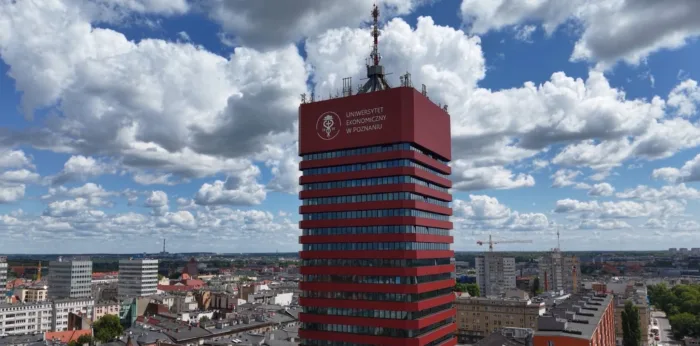
Come and visit the view!
PUEB Viewing Terrace (Taras widokowy UEP)
Link: https://taras.ue.poznan.pl/
Address: Powstańców Wielkopolskich 16, 61-895 Poznań