




Can AI-Generated Marketing Really Be Sustainable?
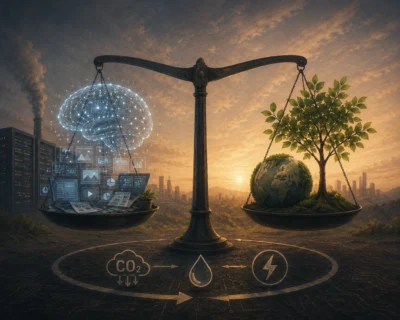
Generative AI is becoming an important part of digital marketing. It helps brands create content faster, personalize messages, analyze consumer behavior, and communicate sustainability more effectively.
However, this creates an important paradox: AI can support sustainability marketing, but generative AI itself is not environmentally neutral.
Garg, Bohara, and Srivastav (2025) show that AI-driven sustainability marketing may strengthen consumer trust, loyalty, green purchase intentions, and the image of eco-friendly brands. Their review points to concrete examples: AI-powered predictive analytics may increase consumer trust by 25%, AI optimization of supply chains may reduce carbon emissions by up to 15%, AI-driven dynamic pricing may increase green product sales by 18%, and AI-powered social media analytics may improve the prediction of eco-friendly behavior by 30%.
At the same time, generative AI has its own environmental footprint. Sidorkin (2025) estimates that a single generative AI query emits approximately 4 grams of CO₂ and uses around 10 milliliters of freshwater. One query may not seem like much, but marketing campaigns often involve hundreds or thousands of prompts, AI-generated images, automated personalization, A/B testing, and repeated optimization.
At the infrastructure level, the numbers are much larger. Sidorkin (2025) reports that global data centers used around 460 TWh of electricity in 2022, while AI servers alone are projected to reach 85–134 TWh annually by 2027. Water consumption is also significant: Google’s data centers consumed around 21 billion liters of water in 2022, and Microsoft’s around 6 billion liters.
This creates a strategic challenge for marketers. AI can help brands communicate sustainability more effectively, but the process of creating AI-generated content also consumes electricity and water. Therefore, AI-generated sustainability marketing should not be treated as automatically “green” only because the message concerns environmental responsibility.
The issue is also connected with consumer trust. If a brand promotes sustainability while using AI mainly to produce more and more content, it may expose itself to accusations of inconsistency or greenwashing.
The key question is therefore not only whether AI can help brands talk about sustainability. The more important question is whether brands can use AI in a way that is consistent with sustainability values.
In sustainability marketing, less may sometimes be more. The brands that benefit most may be those that use AI responsibly, transparently, and only where it creates real value.
Bibliography:
Sidorkin, A. (2025). Environmental Impact of Generative AI: Carbon and Water Footprint. AI-EDU Arxiv.
Garg, V., Bohara, S., & Srivastav, A. (2025). AI-driven sustainability marketing transforming consumers’ perception toward eco-friendly brands. Discover Sustainability, 6(1), 984.
This post is part of the project “People and Algorithms in Organisations: Competences to Work in the Digital Environment” (DIGIT_People and algorithms), funded by the Polish National Agency for Academic Exchange (NAWA).
#DIGIT_NAWA #NAWA #AI #GenerativeAI #SustainabilityMarketing #GreenMarketing #DigitalMarketing #BrandTrust #EcoFriendlyBrands #ArtificialIntelligence #SustainableMarketing #Greenwashing #ConsumerTrust #MarketingTechnology