




What we lose when we stop practising
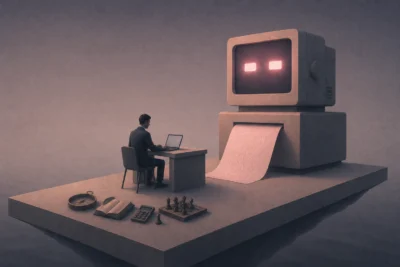
In June, Nature published an article that is worth reading especially carefully. In it, Mariana Lenharo gathers the results of several studies showing that so-called deskilling – the gradual loss of skills in people who rely on AI tools – is no longer merely a hypothesis, but a phenomenon that is beginning to be documented empirically.
The most striking is a study of Polish endoscopists, published in The Lancet Gastroenterology and Hepatology (Budzyń et al., 2025). The physicians, each with a record of at least two thousand colonoscopies, were given access to an AI system that analyses images in real time and flags the presence of adenomas – precancerous lesions. The tool was not available at all times – on some days yes, on others no. The results are instructive. Before AI was introduced, specialists detected at least one adenoma in 28.4% of colonoscopies. After its introduction – but on the days when they worked without support – this figure dropped to 22.4%. The mere fact of working alongside the tool changed their own way of seeing.
The authors put it bluntly: continued exposure to such tools can leave clinicians “less motivated, less focused, and less responsible when making cognitive decisions without AI assistance”. The word “responsible” gives one pause. It is not just a loss of concentration – it is a subtle shift in the sense of who is actually responsible for noticing what matters.
Robert Wachter of UCSF notes that this applies even to the most experienced specialists. Even 2,000 procedures performed did not protect the Polish endoscopists from a weakening of vigilance. Yuichi Mori, one of the study’s co-authors, puts it plainly: “There is no established solution against deskilling right now. It should be a very hot research topic in the next decade.”
Similar signals are emerging in other fields. Lenharo cites a study by Anthropic in which 52 software engineers performed a programming task – some with access to an AI assistant, others without. Surveys also show the unease of the professional groups themselves: 70% of nurses and 77% of physicians in the United States are concerned about losing their skills due to over-reliance on AI.
What follows from this? Kevin Crowston of Syracuse University proposes a modest, and perhaps the most honest, solution: begin with awareness. Simply knowing that deskilling exists may prompt us to reflect on which skills we want to keep and which we are willing to “outsource” to the tool. This is not a question about technology – it is a question of choice.
Perhaps the most difficult thing in all of this is not that we lose certain skills. What is more difficult is that we lose them unconsciously – in small concessions for the sake of comfort, efficiency, time. And that a skill we do not practise disappears not at the moment we decide to give it up, but much earlier – when we stop noticing that we are using it at all.
Source: https://www.nature.com/articles/d41586-026-01947-1
This post is part of the project “People and Algorithms in Organisations: Competences to Work in the Digital Environment” (DIGIT_People and algorithms), funded by the NAWA – Narodowa Agencja Wymiany Akademickiej)