




Nasi pracownicy współautorami monografii wydanej przez Routledge
Z przyjemnością informujemy o ukazaniu się monografii naukowej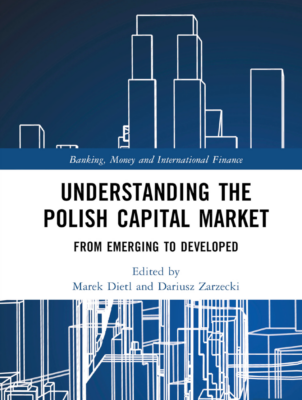 wydanej przez prestiżowe wydawnictwo Routledge:
Understanding the Polish Capital Market. From Emerging to Developed
(red. Marek Dietl, Dariusz Zarzecki; Routledge, London 2022, DOI: 10.4324/9781003298069)
Wśród grona autorów znajdują się również naukowcy z Katedry Finansów Przedsiębiorstw: dr hab. Leszek Czapiewski, prof. UEP; dr hab. Tomasz Jewartowski, prof. UEP; dr hab. Michał Kałdoński, prof. UEP; dr hab. Joanna Lizińska, prof. UEP; dr Szymon Stereńczak.
Chapter 10. Stocks’ liquidity and performance, Szymon Stereńczak
Abstract: Recent studies on liquidity premium in the Polish stock market suggest its small economic relevance. Stock liquidity is significantly priced across a small group of companies with certain characteristics. Using the data on all stocks listed on the Warsaw Stock Exchange (WSE) from 2008 to 2016, we try to answer the question of whether stock liquidity premium differs between stocks preferred by long- and short-term investors. By doing so, we are getting closer to indicating whether stock liquidity is a desired stock feature in the Polish market. We found no significant difference in liquidity premium between stocks held mostly by long-term investors and stocks held mostly by short-term ones. This leads to the conclusion that stock liquidity is not a demanded characteristic of stocks listed on the WSE.
Chapter 12. Institutional investor horizon and payout policies, Michał Kałdoński, Tomasz Jewartowski
Abstract: Institutional investors have become one of the most important groups of shareholders holding more than 40% of global market capitalization (with much higher stakes in many Anglo-Saxon countries). Their presence on the Warsaw Stock Exchange (WSE) is also significant when compared with other markets in the CEE region. Institutional investors differ in many respects, including not only their types, but also investment strategies, which may affect the role they play as shareholders. One of the most important factors that differentiates institutional investors’ motivation for and ability to monitor their portfolio companies is their investment horizon. Many studies confirm that long-term institutional investors improve corporate governance as well as corporate performance and affect corporate financial decisions of their portfolio companies. The purpose of this study is to test whether long-term institutional ownership affects payout policies of companies listed on the WSE. For this reason, we measure institutional investor horizon for all institutional investors with at least a 5% stake in any non-financial company listed on the WSE in the years 2010–2019 in each year (using their portfolio turnovers). Our study reveals a significant positive relation between the institutional investor horizon and payout levels of non-financial companies.
Chapter 13. Earnings quality around equity offerings, Leszek Czapiewski, Joanna Lizińska
Abstract: The initial public offering (IPO) is a profound change in a company’s life. Among many consequences of being a public rather than a private firm are more stringent information requirements. Market participants seek reliable information, and profits are important indicators in assessing a company’s financial condition. This study examines earnings quality of IPO companies in Poland. It is an important practical and academic issue. We apply a set of methods to discuss accrual-based changes in financial reports and active structuring of real transactions. The research provides evidence that IPO companies boost earnings in the IPO year through accruals. However, accrual-based strategies evolve into more conservative ones after going public. The results suggest that market newcomers also influence real transactions. It seems that they are not only interested in increasing profits in the IPO year but also exhibit a long-term strategy of earnings smoothing. They strive for a trade-off between managing earnings through accruals, cash flows from operations, production costs, and discretionary expenses. The relationship between these possibilities is substitutionary to some extent, with some complementary elements as well.