




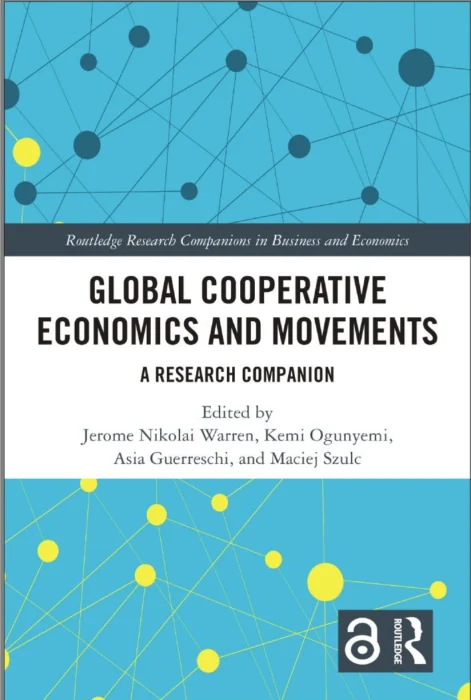
Global Cooperative Economics and Movements - już dostępna!
Nakładem wydawnictwa Routledge ukazało się pierwsze wydanie książki „Global Cooperative Economics and Movements. A Research Companion”. Dr Anna Waligóra z Katedry Socjologii i Etyki Gospodarczej wraz z Ayushi Arora, Kardelen Dilara Cazgir oraz Julią Lisiecką jest współautorką rozdziału „Women’s cooperatives promoting resilience Comparing Indian, Polish and Turkish contexts”. Rozdział poświęcony jest znaczeniu kooperatyw kobiecych oraz kół gospodyń wiejskich dla budowania solidarności społecznej i odporności lokalnych społeczności.
O rozdziale „Women’s cooperatives promoting resilience Comparing Indian, Polish and Turkish contexts”:
Women’s cooperatives around the world have different origin stories, shaped by unique historical, geopolitical, and cultural contexts. Yet all share a common fac‑ tor: women organized around their own needs with their small capital and mobilizing public and or private resources based on solidarity and resilience, responding to urgent social and economic needs within their communities. This chapter examines how women’s cooperatives in India, Poland, and Türkiye evolved, adapted, and responded to socio‑economic shocks, integrating lessons from historical analysis and contemporary literature. Complementing these perspectives, data from 19 semi‑structured interviews with practitioners, policymakers, scholars, and civil society representatives provide insights into current trends, challenges, and innovations. By highlighting both the similarities and differences across these contexts, this chapter illustrates how women’s cooperatives have adapted global cooperative principles to local needs, creating resilient, adaptive, and innovative responses to crises. This analysis underscores the dynamic and interconnected nature of women’s social entrepreneurship and cooperative movements globally
O książce „Global Cooperative Economics and Movements”:
Cooperatives are traditionally recognized as marginal players in the economic sector, but their role in policymaking and in social arenas has garnered even less attention. Over the past two decades, an extensive body of literature in management science and economics has arisen, designating non-capitalistic enterprises as subjects of particular attention. In the context of rising global challenges like economic inequality, environmental sustainability, and labor rights, the role of cooperatives has become increasingly relevant. This book examines the practical and policy dimensions and implications of cooperative economics and movement(s). It delves into the more politicized aspects of cooperatives, exploring how they intersect with global movements, social justice, policymaking, and grassroots activism and provides insights into real struggles tackled by this enterprise form. It offers an understanding of how communication in cooperatives plays a role in promoting principles, values and practices and how these are transferred across generations of cooperators. It provides a deeper understanding of the elements of intergenerational evolution within cooperatives in concepts on employment and labour as new policies are raising expectations. Further, it offers a broad variety of global case studies pertinent to issues of relevance to cooperative economics and management, profiling how different types of cooperatives on six continents can promote sustainability and self-organized community wealth-generation, connecting to development studies, ethics and political economy, while revealing how cooperatives can address the current challenges of the digital age, especially including issues of data governance and artificial intelligence. The book will serve as an invaluable tool for anyone seeking to understand the broader implications of cooperative models in today’s globalized world.
Książka jest dostępna na bazie licencji Creative Commons Attribution-ShareAlike (CC-BY-SA) 4.0 w wersji OA (nieodpłatnie).